
How to Judge a Supplier for Scented Home and Personal Care
A range that scents home and personal care products is not one supplier question, it is three: who can formulate across very different bases, who can test each base properly, and who can keep the scent recognisable from a hand wash to a candle. Evaluating suppliers on a single category track record therefore misses the part that matters most. For a festive gifting range, where the same scent family often appears across several formats in one box, the ability to hold a scent consistent across those formats is the capability being bought. This framework sets out what to ask for, and which answers are worth accepting.
Key takeaways
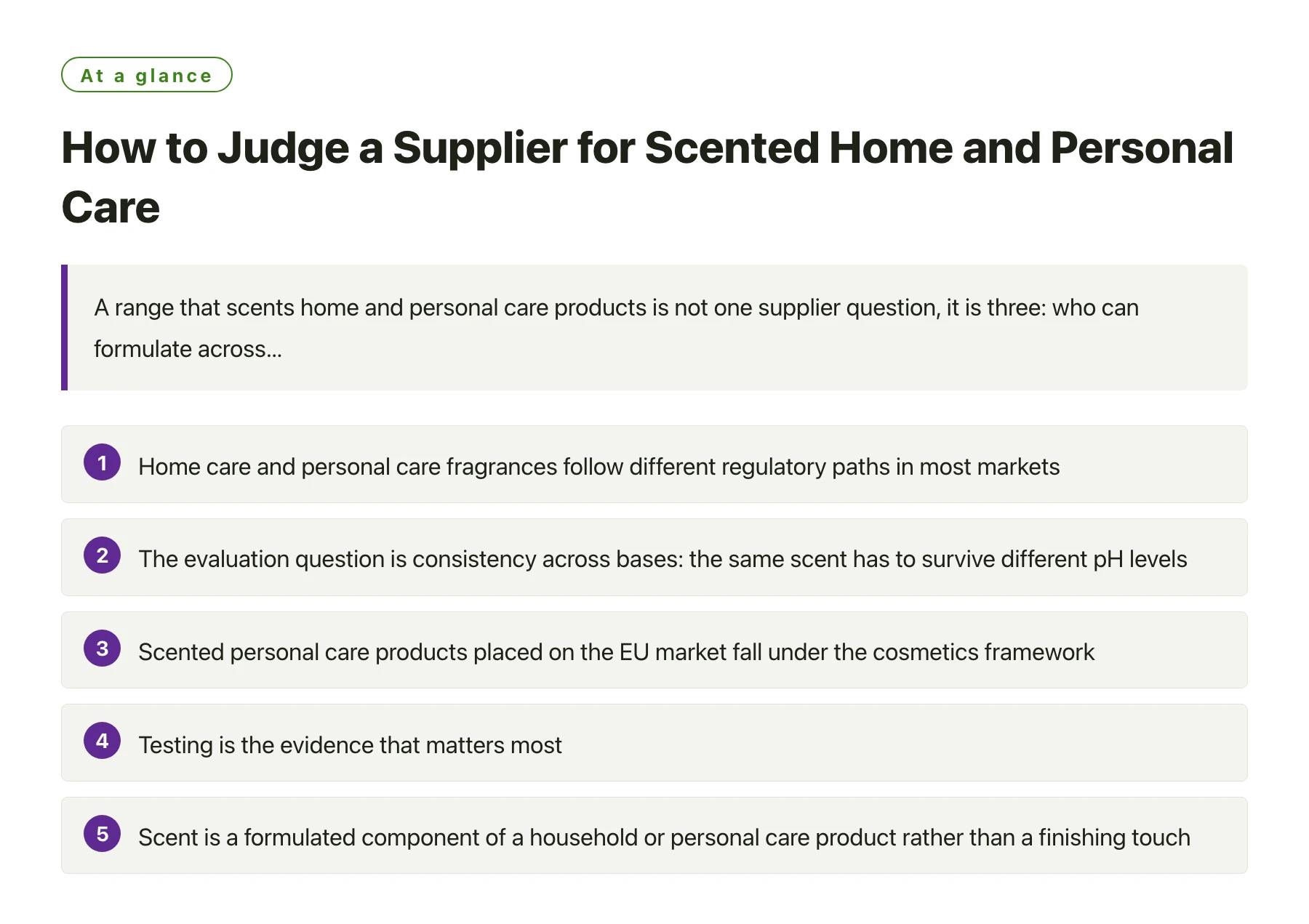
- Home care and personal care fragrances follow different regulatory paths in most markets, so a supplier's experience in one does not automatically transfer to the other.
- The evaluation question is consistency across bases: the same scent has to survive different pH levels, surfactants, packaging materials and temperatures.
- Scented personal care products placed on the EU market fall under the cosmetics framework, which places responsibility on the brand placing them on the market [1].
- Testing is the evidence that matters most, and third-party laboratories publish the scope of cosmetic and household product testing they offer, which helps a buyer decide what to commission independently [2].
- Scent is a formulated component of a household or personal care product rather than a finishing touch, so a supplier that treats it as a purchased additive will underperform on consistency [3].
- For a gifting range, packaging must be evaluated with the formula, because an interaction between a scent and a pack shows up during storage rather than at filling.
Buyers who move from fine fragrance into home and personal care usually bring one assumption with them: that scent is scent. The assumption holds for the creative part and breaks down immediately after it. A composition that performs beautifully in an alcohol base may behave differently in a surfactant system, a lotion or a wax, and the difference is not a matter of taste but of chemistry and testing.
This is why supplier evaluation in this category is less about portfolio breadth and more about method. The supplier has to be able to develop or adapt a scent for each base, test it in each base, and demonstrate that the result still reads as the same scent when the customer opens the box. A festive gifting range makes that requirement explicit, because the box is the product: a body wash, a lotion and a candle that smell like three different things is a failed range even if each item is pleasant.
What follows is an evaluation framework built from a category buyer's perspective, with the evidence worth requesting and the signals that a supplier is answering from experience rather than from a brochure.
Supplier evaluation framework for a scented home and personal care range
| Evaluation area | Evidence worth requesting | Weak answer |
|---|---|---|
| Cross-base development | A description of how the scent is adapted for each base, and what changes between them | 'The same formula works in everything' |
| Testing scope | A named list of tests per product and pack combination, with the conditions used | 'We test everything before shipping' |
| Regulatory position | Clarity on which products are treated as cosmetics and which are not, and who holds the responsibility on the label [1] | A single answer applied to the whole range |
| Packaging interaction | Compatibility work linking each formula to its specific pack and closure | Packaging treated as a separate purchasing decision |
| Consistency across formats | A demonstration that the scent reads as one family across the range, using coded samples | Reliance on the brand's own nose at the review meeting |
| Capacity and calendar | Which stage of the range is the constraint in the pre-holiday window | 'We have capacity' with no stage named |
| Handover | What the brand receives: specifications per product, test reports, retained references | A promise that documents can be provided if needed |
Read together, the rows describe a supplier that expects to be judged on evidence rather than on impressions. That is the right standard for this category, because the failure mode is invisible at the review meeting and obvious three months later. It is also the standard worth applying to a contract manufacturer for perfume brands before a gifting range is committed.
The three questions that decide most evaluations
The first question is which bases the supplier has actually formulated for, in production rather than in a proposal. Formulating for a lotion and filling a lotion are different capabilities, and the useful evidence is a specification for a product that has been made repeatedly, not a list of categories the company has worked with.
The second is who owns the compatibility work. Some suppliers test the scent in the pack and hold the reports; others treat testing as the brand's responsibility and the pack as a third-party purchase. Both arrangements exist, and they lead to very different project calendars. The decisive point is not which one is better in the abstract but whether the brand knows which one it is buying.
Home care and personal care are not the same project
A single gifting range can include a hand wash, a body lotion and a scented candle, and those three items do not sit under the same rules or the same technical constraints. Personal care products applied to skin are treated as cosmetics in many markets, while household products such as candles and surface sprays follow other frameworks. The practical consequence is that the label text, the required safety documentation and sometimes the ingredient disclosure differ across the box even when the scent is identical.
A supplier that can state where the boundary falls, and what changes as a result, is giving a more valuable answer than one that offers a generic compliance promise. It also helps to know which parts of the documentation the brand must hold in its own name, because responsibility for a cosmetic product generally sits with the entity that places it on the market [1].
Testing is where an evaluation becomes verifiable
Compatibility and stability testing turns a supplier's confidence into a record. The tests worth commissioning are those that combine a formula with its actual pack under conditions the product will meet: time, temperature variation, light and, for some formats, contact with a pump or a cap material. Laboratories publish the scope of the testing they offer for cosmetics, personal care and household products, which is a useful reference when deciding what to request and what to verify independently [2].
The reason this belongs in the evaluation rather than in the production plan is that testing capacity has its own lead time. A range that commissions tests late in the calendar ends up waiting for results during the weeks when it should be producing. Asking a prospective supplier how testing is scheduled relative to production reveals whether they have done this before.
Scent as a formulated component
Industry coverage of household and personal products treats fragrance as a formulated ingredient with its own performance and stability considerations, not as a purchased finish applied at the end [3]. That framing has a direct consequence for evaluation: the supplier's formulators and the fragrance developers have to work as one team, because a change to a base can change how the scent performs and a change to the scent can change how the base behaves.
When a festive gifting range is assembled, this collaboration is what keeps the range coherent. It is also the reason a brand should ask to see how a formula change is communicated between the two sides, and how quickly a revision reaches the people who need to act on it. Comparing suppliers on those mechanics is more productive than comparing them on portfolio size, and it is the same discipline that shows up when how to compare perfume factories are placed side by side. Brands that want a reference point for what a single operation spanning several formats actually looks like can study how Xuelei Fragrances presents its own scope before the brief goes out.
One evaluation habit is worth more than any single criterion: ask each supplier to walk through a real product, from brief to filled pack, naming the tests, the approvals and the one step that most often delays them. A supplier that describes a specific step and what it does about it is answering from experience. A supplier that describes the process generically is answering from a diagram. On a festive gifting range, that difference is the difference between a range that lands and a range that is still being adjusted when the window opens.
Sources
- European Commission: Cosmetics in the EU —— The European Commission's overview of EU cosmetics rules, including the responsible person, product information file and safety report requirements.
- SGS: Cosmetics, Personal Care & Household Testing —— Testing, inspection and certification services for cosmetics and personal care, including microbiological, stability and safety testing aligned with cosmetics GMP.
- HAPPI — Household & Personal Products Industry —— An industry magazine covering the household and personal care market, including fragrance, formulation and packaging.
Frequently asked questions
Can one supplier handle both home and personal care fragrance?
Often yes, but the two product worlds have different formats, testing requirements and in many markets different rules. The question to ask is not whether a supplier can formulate both, but whether it can test both in the actual packs and document the results for each.
How do we keep one scent consistent across several product formats?
By treating the range as one brief with several technical problems. The scent family is fixed, then adapted and tested per base, and the adaptation is recorded. Consistency is verified with coded samples across the whole range rather than by judging each item on its own.
Which tests should be commissioned independently?
That depends on the market and the product, but compatibility between formula and pack, and stability under realistic conditions, are the two that most often justify independent verification. Laboratories publish the scope of what they offer, which helps in specifying the request.
Does a gifting range need extra packaging testing?
It usually needs the same testing plus an assembly check, because gift formats add outer boxes and inserts that the customer handles. An insert that fits during assembly but deforms in storage can damage a bottle before the customer ever sees it.
What is a reasonable way to compare two suppliers for this category?
Give both the same brief and ask for the same artefact: a specification for a comparable product, the test list, the calendar with the binding stage named, and the handover document list. Comparing answers to identical questions is the only reliable method.
¿Necesita una valoración discreta?
Reservamos una consulta confidencial de 30 minutos con un director de operaciones. Sin compromiso, sin trazabilidad.
Solicitar consulta confidencial→