
Sampling at 25–30 Days: An OEM Jewelry Schedule
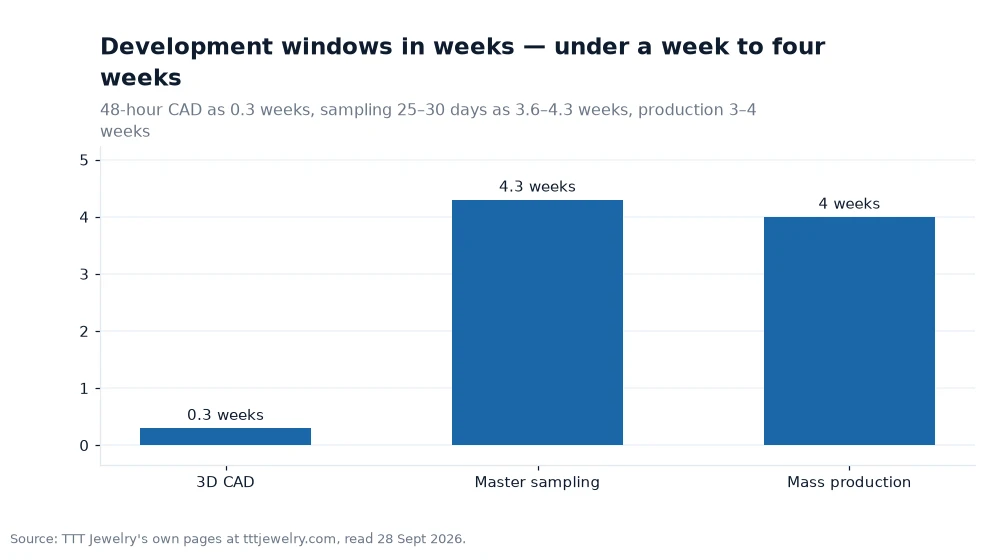
A 25–30 day sampling window is the longest fixed block in a custom jewelry order, and the one buyers most often misplace on the calendar. TTT Jewelry publishes 25–30 days for master sampling, 48 hours for 3D CAD and 21–28 days for bulk production. Added in sequence, those blocks put the path from approved brief to dispatch at 48–60 days, or about seven to nine weeks.
Key takeaways
- Master sampling is quoted at 25–30 days, equal to 3.6–4.3 weeks, and starts after 48 hours of CAD work.
- Bulk production adds 21–28 days, so brief-to-dispatch totals 48–60 days.
- Five bench operations share the sample window, at roughly six days each.
- Approval is a gate: a rejected sample sends the design back through CAD before a new 25–30 day block begins.
What the 25–30 days actually buy
The sampling window covers a physical piece, not a drawing. TTT Jewelry runs its OEM/ODM work under an ISO 9001:2015 quality system, so the same bench sequence is recorded at every stage. One design moves through five operations inside those weeks: mould casting, 3D wax printing, stone setting, polishing and electroplating. The published chart splits the 25–30 day block into five slots of about six days, which explains why the window cannot be shortened by asking for faster plating on its own. Each operation has a queue in front of it and a check behind it.
Casting comes first because the mould fixes the geometry that every later step works against. Wax printing builds the pattern tree that feeds the casting flask. Stone setting follows the metal work, since a set stone will not survive a rough polishing pass. Polishing sits before plating for the same reason: a scratch under a 14K gold layer stays visible through the gold. Electroplating closes the sequence, because the surface has to be clean, sharp and free of burrs before current hits the bath.
Building the calendar backwards
Work back from the date stock must be in hand. Take a launch date, subtract 21–28 days for production, subtract another 25–30 days for the master sample, then subtract two days for CAD. What remains is the latest date for a signed brief and a complete specification.
Buyers planning seasonal ranges for custom jewelry wholesale programmes usually run the same arithmetic in the other direction: they fix the ship date, then set internal deadlines for design selection, artwork approval and packaging copy. All of those deadlines sit ahead of the CAD release. If packaging artwork is signed off in the same week as the sample, the order is already late by the length of the packaging lead time, which is not a jewellery operation at all.
Two days of CAD looks trivial against 25–30 days of sampling, and it is: 48 hours is 8% of a 25-day window and 6.7% of a 30-day one. The reason CAD still matters is that nothing starts without it. A late drawing pushes the whole chain, and the sample queue does not wait for a buyer who is still choosing between two clasp styles.
Where the buyer's own delays land
Most slippage in a sampling schedule comes from information the factory does not have, not from the bench. A plater cannot match a finish described as golden or as looking like the photo. A setter cannot choose a stone size from a mood board. The table below lists the input that unlocks each stage; treat those inputs as gates rather than requests.
| Stage | Published duration | Input that releases it |
|---|---|---|
| Brief and consultation | No fixed duration in the published flow | Target material, order quantity, price band |
| 3D CAD | Under 48 hours | Reference images, dimensions, logo vector file |
| Master sampling | 25–30 days | CAD approval and stone selection |
| Sample approval | Buyer-side decision | Fit test, plating colour check, hallmark position |
| Bulk production | 21–28 days | Signed sample and purchase order |
| Final QC and delivery | 100% inspection, then shipping | Packing list, barcode and labelling files |
Two inputs cause more rework than any other: stone colour and logo scale. A stone described as champagne can arrive warmer or cooler than the reference image, and a logo drawn at one size may become illegible at the size the piece allows. Both are cheap to settle on paper and expensive to settle after casting, because the correction runs through CAD, a new mould insert and another sample slot.
Running two designs without doubling the wait
Two colourways of one ring are not two full sampling cycles. Ask an OEM jewelry manufacturer how a family of pieces is tooled and the answer usually turns on the mould. That tool is the heavy part of the sample, and variants that share geometry can be cast from it, with plating split at the end. That is where a real saving can appear, and it is the reason buyers should describe a family of pieces at brief stage rather than one SKU at a time.
Two unrelated designs behave differently. Each needs its own CAD file, its own mould and its own setting plan, and each occupies bench time. A factory running both at once is doubling the queue, not halving it. Ask for a written sequence: which design casts first, when the second enters polishing, and what happens to the second if the first is rejected at approval. That sequence is the part of the schedule a buyer can actually manage, because the bench work itself is already fixed at five operations per design.
Worked example
Suppose a brand needs stock on 15 November. Working back with the published windows: 15 November minus 60 days is 16 September, and 15 November minus 48 days is 28 September. The order therefore has to be released between 16 and 28 September to cover the slow and fast ends of the schedule.
Inside that block, CAD takes 48 hours, or two days. If the drawing is signed off on 18 September, the master sample lands 25–30 days later, between 13 October (25 days) and 18 October (30 days). Production then adds 21–28 days: 13 October plus 21 days is 3 November, and 18 October plus 28 days is 15 November. The fast end of sampling paired with the slow end of production still reaches the launch date, with no room for a second sample. One rejection at approval uses the entire buffer.
Frequently asked questions
Does the sampling window include 3D CAD?
No. CAD is quoted at under 48 hours and runs before the sample. The 25–30 day clock starts when the drawing is approved, so the two blocks are added together rather than overlapped.
What happens if the first sample is rejected?
The design returns to CAD for correction, then a new master sample is made. A second 25–30 day block begins, which is why an approval date matters as much as a ship date.
Can production start while the sample is still in review?
Not on a custom piece. Bulk production follows sample approval because the approved sample is the reference for the whole run, including plating colour and stone placement.
The buffer belongs at the front
Buyers who leave three weeks spare before a launch are usually buying a second sampling round; buyers who leave none are betting that the first sample passes. A schedule quoted at 25–30 days is a bench process with five operations inside it, and the way to protect it is to lock artwork, stones and approvals before the CAD file is released. For ranges that sit alongside plated lines, it also helps to read the custom brass jewelry pages before the brief is written, because the base metal choice changes both the tooling route and the order quantity.
Source note: figures come from the manufacturer's own website (tttjewelry.com), read 28 Sept 2026.[1]